
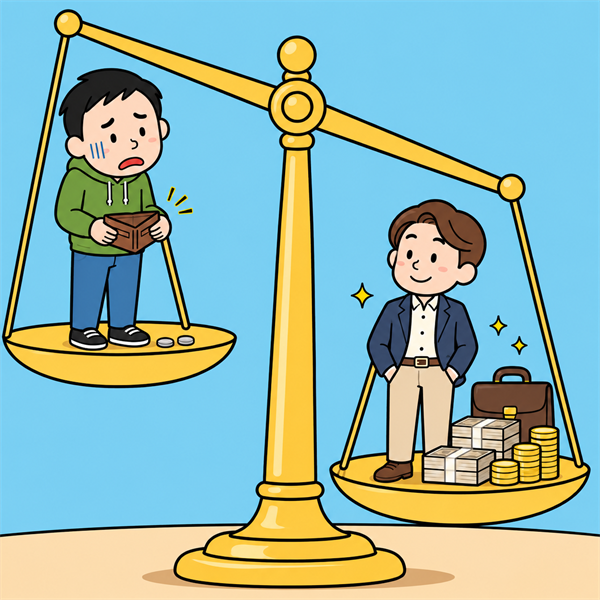
- You try to do the right thing, but feel you keep getting the short end of the stick.
- Comparing yourself with people who have more advantages leaves you frustrated.
- You want your days to feel a little easier without just putting up with unfair treatment.

I feel like I’m the only one trying so hard.
Life really is unfair, isn’t it?

You don’t have to put up with everything.
Let’s think together about what’s troubling you right now.
You work honestly and seriously, but the people who know how to play the game seem to come out ahead.
You take care of things at home, and before you know it, everyone assumes they’re your responsibility.
When that keeps happening, you want to say, “Why is life so unfair?” don’t you?
Then, when you talk about how frustrated you feel, someone says, “There’s no point comparing yourself with others.”
I know that… But the problem is, I can’t just feel okay about it.
Maybe that’s how you’re feeling right now.
I don’t think you have to force that frustration away.
You didn’t choose the family you were born into, or everything that has happened to you along the way.
In this article, when life feels unfair…
I’d like to talk about what you can think through and what you might be able to do.
I’m not going to leave it at, “Just accept it and keep trying.”
Let’s also look at the things actually making life hard, like your workload or family responsibilities.
When Life Feels Unfair, It Isn’t All Your Fault

The first thing I want you to hear is that you don’t have to explain all your pain as a lack of effort on your part.
No matter how hard you try, some things aren’t yours alone to decide.
As you read, think about the situations that make life feel unfair to you.
You Don’t Choose the Circumstances You’re Born Into
Some people had support from home when they wanted to continue their education.
Others had to think first about working to help support their household.
Even among friends your own age, everyone started in different circumstances.
And in adulthood, the time you can use freely and whether you have family to rely on differ from person to person, too.
When someone ignores all that and says something like, “The people who work hard are the ones who win”…
I find myself thinking, “Hang on. It’s not that simple.”
Of course, a friend who seems fortunate may still have worked hard.
They may have put in a lot of effort and faced struggles you haven’t seen.
But that doesn’t erase the fact that your own circumstances were difficult.
You’re allowed to feel disappointed and think, “I wish I’d had those advantages, too.”
And with that feeling still there, you can ask, “What could I do now?”
There’s room both to feel hurt about the past and to think about your future.
Sometimes Your Efforts Don’t Get Rewarded
You spent more time preparing than anyone else, but someone else got the recognition.
Of course that stings.
“Does nobody see what I’ve been doing…? (;´д`)”
You may find yourself feeling that way.
Results and recognition at work don’t always depend on your effort alone.
What did the people evaluating you consider important? What role were you given? Did you have help from those around you?
There may be circumstances you can’t see.
So you don’t have to jump to, “I didn’t try hard enough.”
How about finding out what was expected instead?
You could ask, “Could you tell me specifically what was missing in this evaluation?”
You may not feel satisfied with their explanation.
Even so, it can give you a clearer idea of what to do next than continuing to blame yourself without knowing.
Comparing Your Pain With Someone Else’s Doesn’t Make It Disappear
“There are people in the world who have it much harder.”
Hearing that can leave you feeling you have nothing you’re allowed to say.
You have a home and something to eat.
Maybe complaining when you have all that is asking for too much…
But does that mean you have to think, “I should be grateful, so I must keep quiet and put up with it”?
I don’t think so.
You can be grateful and still ask for help when you’re struggling.
You can appreciate having a family and still get tired if you carry all the housework alone.
You can be thankful for your job and still struggle when an unreasonable workload keeps landing on you.
It’s okay to talk about what’s troubling you as a difficulty that matters in your own life.
Unfair Experiences Don’t Have to Define Your Worth

When something unfair happens, frustration can come with a feeling that your own life has nothing in it.
But differences in your circumstances don’t mean differences in your worth as a person.
I’d like you to pause and think about that for a moment.
Don’t Fill In Someone Else’s Whole Life and Compare It With Yours
You hear that someone you know has built a lovely house.
Apparently, their parents helped pay for it, too.
It’s understandable to think, “Must be nice. I’m paying for everything myself.”
When the financial help available is different, the burden really is different.
But you don’t have to go on to decide, “Everything in their life is going well,” and, “I’m losing at everything.”
What you actually know is the story about this house.
If you start comparing their marriage, work, and future from there, it can go on forever.
Be honest with yourself that you feel envious.
But try not to imagine the parts you don’t know and use them to bring yourself down.
Then asking, “What’s bothering me about my own home right now?” might be more useful for the life you’re actually living.
Don’t Choose Things You Don’t Want Just to Prove Someone Wrong
“One day, I’ll show them!”
I think that feeling can give us energy to try sometimes.
Feeling hurt may be part of what helps you take another shot.
But there’s one thing I’d like you to watch out for.
Are you choosing things you don’t really want just so you can beat the other person?
You want time off, but take on more work because you don’t want to earn less than they do.
Money is tight, but you buy something expensive to keep up appearances.
They’re going about their life without thinking about it, while yours keeps getting harder.
Doesn’t that feel frustrating in its own way? (´д`|||)
“If that person weren’t watching, would I still want to do this?”
Try asking yourself that once.
If you want to do it, you can keep going. If you don’t, you’re allowed to think again.
Accepting Reality Doesn’t Mean Putting Up With Everything
Life is full of things that don’t go the way we want.
But that doesn’t mean you have no choice but to put up with anything anyone does to you.
You keep being treated badly at work.
The division of housework is unfair, but you feel unable to discuss it.
Before you resign yourself to, “That’s just how it is,” ask what you want to change right now.
Some things can be talked through. Others may call for someone’s help.
You don’t have to persuade the other person all by yourself.
If you’re afraid of them and can’t speak up, it’s okay to talk with someone you can explain the situation to before trying to discuss it directly.
Working to change something unfair and caring for your own heart don’t have to be either-or choices.
Please don’t push yourself so far that you feel broken inside.
4 Things to Help Protect Your Everyday Life When Things Are Unfair

You can’t get rid of every unfair thing in the world today.
But that doesn’t mean you have to end the day feeling there’s nothing you can do.
Choose one thing that seems possible for you right now.
1. Write Honestly About What Hurt
Instead of searching for a positive answer right away, start by writing what felt so upsetting.
It doesn’t have to be beautifully written.
Use paper or your phone’s notes, without planning to show it to anyone.
These are notes to help you understand your own feelings.
“This week, I was the only one who stayed behind to clean up again.”
“It hurt when my help was treated as though it hadn’t happened.”
“Next week, I’d like us to take turns or agree on who does what beforehand.”
When you remember what happened and write it out like that…
Your honest feelings and what you want can gradually become clearer.
It becomes easier to see what to ask for than when all you could say was, “Life is unfair.”
You don’t have to send these notes to the other person.
Think separately about what to say to them once you feel a little calmer.
Tonight, simply writing, “That hurt,” can be enough.
2. Talk to Someone About It
Choose just one thing from the notes you wrote.
Ask yourself, “Who could I talk to that might help this move forward a little?”
For a work evaluation, someone who can explain the reasons behind it.
For family responsibilities, a family member who can help agree on how to share them.
For difficulties in daily life, a local government advice service. In Japan, these are available through municipal offices.
Your notes before the conversation don’t have to be long.
What has been happening, and since when?
What is that making difficult for you now?
What do you want to find out or ask to have changed?
Having those three things in mind may make it easier to begin.
You’re allowed to draw on someone else’s ideas, instead of feeling you have to keep figuring it out alone.
3. What Kind of Life Do You Really Want?
“I wish I’d had a more fortunate life.”
When you think that, what exactly are you wishing for?
Money? Time to rest? Or someone to say, “I see how hard you’re trying”?
Even when we use the same word, “unfair,” what we want can be different.
For example, you might envy a coworker’s freedom, then realize what you really want is one unhurried day off each month.
Once you know that, there are things to consider besides working in exactly the same way as they do.
Ask about your preferred days off early.
Arrange help with family responsibilities in advance.
Leave a day without packing your schedule full.
That won’t solve every unfair thing at work.
While you work on what needs to improve, you can also look for practical ways to make room for the time you want.
Please give weight to what’s really troubling you and what you really want, rather than an answer that looks impressive to everyone else (*´ω`*)
4. You’re Allowed to Enjoy a Day That Has Hurt
On a day when something unfair happens, it can be all you think about.
You’ve finally come home, but in your head you’re still arguing with the other person.
Even over dinner, you keep thinking, “I should have said that.”
At times like that, it’s okay to do something else for a little while.
Laugh with your family about something unimportant.
Savor a meal your wife made for you.
Notice a beautiful sunset while you’re out walking.
You don’t need to think, “The problem isn’t solved, so this is no time to enjoy myself.”
Laughing doesn’t mean you’ve agreed that the unfair treatment was okay.
An unpleasant experience doesn’t have to take away every good part of your evening, too.
If you take a bite and think, “Oh, this is good,” you’re allowed to simply enjoy that moment (*´ω`*)
To Close: You Don’t Have to Carry the Hurt Alone

There really are things in life that feel unfair.
But unfair circumstances don’t mean you have to think less of your own worth.
Put what hurt into words, and choose one thing you could ask someone about now.
And even on days when the problem remains, care for your own everyday life.
Today, I’d like to share these words from the Bible with you.
Blessed are the peacemakers, for they will be called sons of God.
Matthew 5:9 (BSB)
This is how Jesus blesses the lives of those who make peace.
What I’d like you to think about here isn’t, “As long as I put up with it, everything will stay peaceful.”
It’s about telling the other person what’s hard for you, too, while looking for a way for both of you to feel at ease.
Suppose you’re always the one accompanying a parent to medical appointments.
A sibling messages, “Thanks for taking care of it again this week!” and you want to fire back, “Why don’t you do it yourself for once?”
Before you hit send, could you pause for a moment?
Try telling God honestly in your heart, “I’m really angry right now.”
Then pray, “Please help me tell them how I really feel without attacking them.”
Afterward, say what you’d like them to do: “I need a break this week, too. Could you take over the drive there and back on Wednesday?”
I think that will often lead to a better outcome than replying in anger (*´ω`*)
The Christian life isn’t about burying your real feelings and always playing the nice person.
You can tell God what’s really on your heart and ask for wisdom and help as you consider how to treat others.
I’d be glad if you could know that this is one way to ask for support, too.
You don’t have to look at something unfair today and immediately say, “It was all for the best.”
Start with a conversation that might make tomorrow a little easier for you (*´ω`*)
For You Who Feel You Have to Handle Everything Alone
Thank you for reading all the way to the end.
“Maybe looking at things this way could make life feel a little lighter.”
If anything here made you feel that way, would you let me share a little more of my story?
I used to think everything through on my own and rely on my own strength to get through it.
I thought that was what it meant to be a strong, capable man. For years, that was the kind of life I kept chasing.
But it also meant that when things went wrong, I felt I had to fix everything myself.
So I kept pushing myself harder and harder, and my heart never really found rest.
After becoming a Christian at 50, I discovered ways of thinking in the Bible that I had never known before.
For example:
When I fail, God does not give up on me. He gives me courage to begin again.
When comparing myself with others leaves me discouraged, He reminds me that I matter.
When I am being stubborn, He helps me say a sincere “I’m sorry.”
When I am worn out from trying so hard, He welcomes me in my weakness and invites me to rest.
When the future feels uncertain, He reassures me that I do not have to carry it all alone.
I found so much wisdom for those ordinary, everyday struggles.
“The Bible talks about things like that, too?”
As someone who had never believed in religion, I was surprised.
In this free email series, I share what I have discovered while reading the Bible and how it has helped me rethink the way I live.
After 50 years of searching, I can honestly call it “life’s greatest treasure.”
You do not need to have read the Bible before.
If you are simply curious about what I have to share, I would be happy for you to read along.
As life goes on, new worries are bound to come up.
At those times, I hope you might remember, “There was another way of looking at this.”
That is what I want to share with you: stories and reflections that can help fill your heart with peace.
(Free) ⇒ Receive Life’s Greatest Treasure by Email